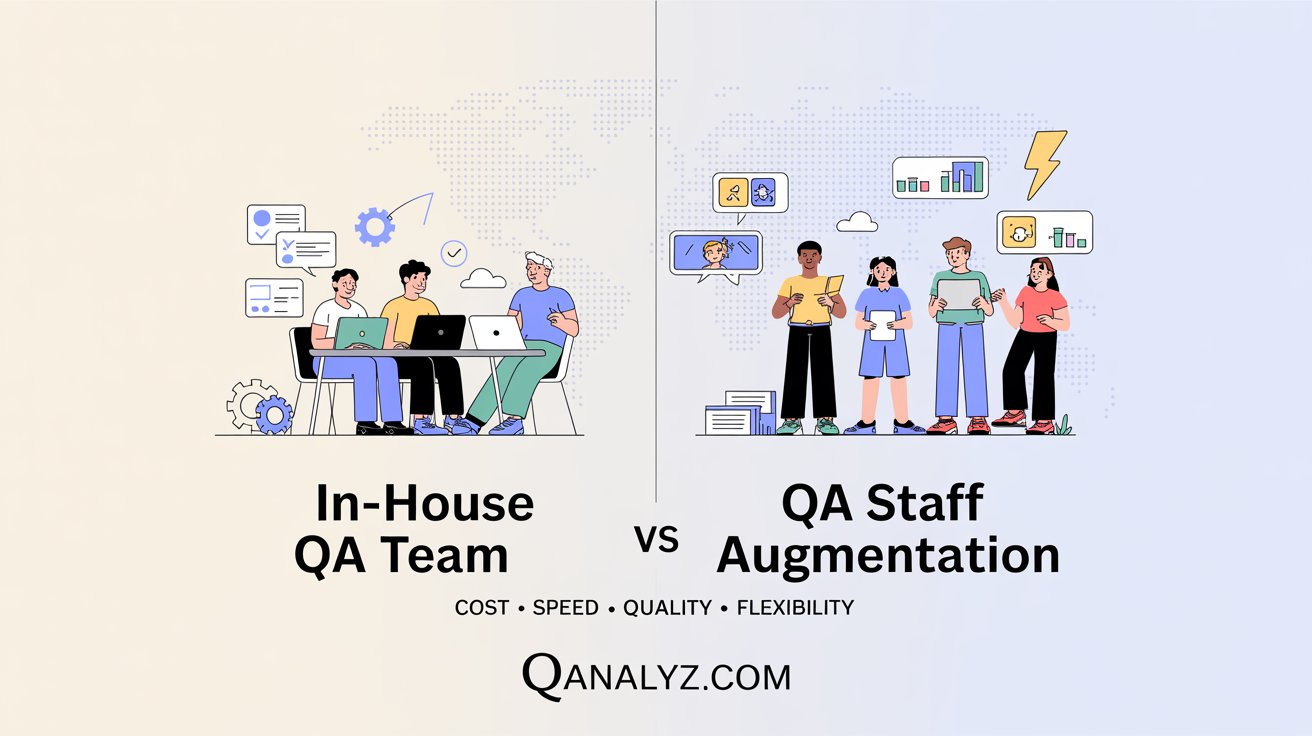
In a world where software delivery cycles accelerate every quarter, organizations — from startups to global enterprises — face a fundamental talent question: Should we build our QA/testing team in-house, or scale it through software testing staff augmentation?
This is not just a cost question. It’s a strategic decision that affects quality outcomes, team agility, time-to-market, and long-term innovation.
At QAnalyz, we help engineering teams remove the complexity from QA decisions by offering flexible, high-impact software testing services tailored to real business needs. If you’re exploring the most cost-effective QA approach for your product, get in touch with our team for a tailored quote and expert guidance.
In this guide, you’ll get a clear framework for choosing the right model, real business examples, practical ROI insights, and a comparison of both approaches — beyond simple cost tables — so you can confidently make decisions that align with your technical and business goals.
1. Understanding the Two Models
In-House QA Hiring
In-house QA hiring means recruiting full-time quality assurance engineers, automation developers, performance testers, security testers, and test architects as permanent employees within your organization.
Core Strengths of In-House QA
- Deep domain knowledge: Permanent QA staff become intimately familiar with your product, codebase, and business logic.
- Cultural alignment and continuity: In-house teams often have stronger internal collaboration, aligning QA strategy with company goals.
- Control and oversight: Full managerial control over work, processes, and quality standards.
Limitations
- Long hiring cycles and steep onboarding costs.
- Fixed overhead that doesn’t flex with project demands.
- Limited agility when workloads spike or pivot.
In addition, recruiting in competitive markets can take six weeks or more on average, slowing delivery plans.
Software Testing Staff Augmentation
Staff augmentation involves contracting external QA specialists (manual testers, automation engineers, security testers, performance experts, QA leads) to work alongside your internal team as needed.
Think of it like turning on talent on demand: you bring in experts this week for regression automation and scale back next month when a critical phase ends.
Key Benefits
- Rapid onboarding: Skilled testers can integrate with active teams within a few days.
- Scalable expertise: Hire performance testers just for load testing cycles; bring in security QA for compliance sprint.
- Variable cost structure: Convert fixed HR costs into flexible expenditure aligned with workload. Staff augmentation is not a replacement for QA leadership — it complements internal capabilities when strategic demand varies.
Cost Category | Approach |
Recruitment | Provided by partner (zero HR hiring cost). |
Onboarding | Days to weeks — not months. |
Pay Structure | Hourly or monthly — align with real workload. |
Benefits | Handled by vendor. |
Tool Access | Often shared or vendor-provided. |
Scale | Up/down instantly with demand. |
ROI Insight: Many teams report 40–60% cost savings on testing capacity compared to full-time employees when staff augmentation is used strategically.
3. Speed & Time-to-Market
Faster testing isn’t just “nice to have” — it determines release velocity, feature adoption, and revenue impact.
- In-house QA can take 4–12 weeks before new hires contribute measurably.
- With staff augmentation, experienced testers join active sprints in days, not months. (
This difference directly affects:
- Regression cycles
- Feature launches
- Customer feedback loops
- Bug escape rates
Example: A mid-sized SaaS company preparing for a major feature release used QA staff augmentation to bring in automation specialists. Test cycles that previously took 3 weeks were reduced to 9 days, enabling a market window capture — an outcome valued at millions. (Industry practice analysis suggests that delayed releases often cost companies opportunity and revenue losses.
4. Quality Impact & Risk Reduction
Quality isn’t just a testing phase — it’s a process embedded throughout development.
Staff augmentation specialists bring:
- Shift-left testing practices
- Experience with CI/CD pipelines
- Tool fluency (Selenium, Cypress, Playwright)
- Domain testing knowledge (security scanning, performance benches)
Integrating quality early prevents defects from reaching production — reducing costly rework and support overhead.
Real Outcome: Teams that embed augmented QA expertise early report fewer production bugs, higher regression confidence, and faster issue turnaround — metrics that directly affect customer satisfaction and retention.
Decision Framework: When to Use Which Model
Choosing a model isn’t binary — it depends on project type, complexity, timeline, and budget rhythm. Here’s a practical framework:
Hybrid Strategy
Many leaders adopt a hybrid approach: maintain a lean core QA team and bring in external experts for release spikes, specialized workflows, or automation build-outs. This balances quality ownership with cost flexibility.
Scenario | Recommended Model |
Stable product, long roadmap, strong core QA | In-House with strategic augmentation |
Seasonal spikes, regulatory deadlines | Staff Augmentation |
Need specialized QA skills (security, performance, AI frameworks) | Staff Augmentation |
Rapid scale-up for MVP or new market entry | Staff Augmentation |
Building proprietary testing IP and institutional knowledge | In-House |
6. Common Objections & Real Answers
Objection: “We lose control when QA isn’t in-house.”
Answer: Clear governance, shared processes, and integrated tooling keep augmented teams aligned — often better than scattered outsourcing. Regular sprint rituals, performance dashboards, and shared KPIs ensure accountability.
Objection: “Augmented testers won’t understand our product domain.”
Answer: With targeted onboarding and collaboration tools (shared test cases, issue trackers, onboarding docs), even temporary testers ramp in days. Many augmentations embed testers into cross-functional pods to deepen product context.
Objection: “Costs will spike unpredictably.”
Answer: With well-scoped contracts, resource calendars, and defined deliverables, augmentation spend is predictable and tied to outcomes — not surprises.
7. Practical Next Steps for Leaders
To evaluate your QA strategy:
- Map QA demand patterns over the next 12 months.
- Estimate peak workloads (regression cycles, automation builds).
- Define quality KPIs tied to business outcomes.
- Compare cost models with real salary and vendor rates.
- Pilot augmentation for one cycle, then measure quality and delivery impact.
Conclusion
There is no one-size-fits-all in QA staffing. But for most modern tech teams facing uncertain workloads, rapid innovation cycles, and skill specialization demands, software testing staff augmentation offers a strategic advantage — delivering flexibility, cost efficiency, and quality without long-term commitments.
Leaders who combine a lean core QA team with on-demand augmentation gain both institutional knowledge and delivery agility — a powerful combination for competitive execution in 2026 and beyond.
QAnalyz — Real Testers. Real QA. Real Growth.