If your product isn’t converting, it’s not a marketing problem. It’s a usability problem.
Users don’t read your roadmap. They don’t care about your tech stack. They judge your product in milliseconds—and decide whether to stay, struggle, or leave.
Research consistently shows that users form first impressions in under 50 milliseconds. That means your product isn’t competing on features first—it’s competing on clarity, ease, and experience.
And here’s the uncomfortable truth:
Every confusing click, every broken flow, every hesitation point = lost revenue.
That’s why companies investing in usability testing services aren’t just improving UX—they’re directly increasing conversions, retention, and customer lifetime value.
But here’s the problem:
Most “top usability testing companies” lists don’t help you choose—they overwhelm you.
This guide fixes that.
Why Most Usability Testing Efforts Fail (And Waste Budget)
Before choosing from the top usability testing companies, you need to understand why most UX testing fails in the first place.
Because the wrong partner doesn’t just give you bad insights—it gives you false confidence.
1. Fake or Low-Quality User Data
Many platforms rely on generic testers who don’t match your actual users.
Result:
- Feedback that looks useful
- But doesn’t reflect real buying behavior
2.Tool-Only Approach (No Strategic Thinking)
Platforms like UserTesting or Maze are powerful—but tools alone don’t solve UX problems.
Without expert analysis:
- You get data
- But no direction
3. Shallow Insights (Surface-Level Observations)
Most reports tell you what happened, not:
- Why users struggled
- What to fix first
- What impacts revenue
- No Connection to Business Metrics
UX is treated as “design improvement” instead of:
- Conversion optimization
- Funnel performance
- Revenue growth
The result?
You run tests but nothing truly improves.
What Actually Defines a Top Usability Testing Company
Not all UX testing companies are equal. The best ones operate at the intersection of:
- UX research
- Behavioral psychology
- Data analytics
- QA engineering
Here’s what truly separates top-tier partners:
1. Depth of Testing Methodology
Top companies don’t rely on one method. They combine:
- Moderated & unmoderated testing
- Exploratory testing
- Task-based analysis
- Journey mapping
3. Real Users vs Synthetic Testing
Elite providers use:
- Targeted user personas
- Market-matched testers
- Context-aware scenarios
3. AI-Powered Insights (Next-Gen Advantage)
Modern usability testing includes:
- Behavior prediction
- Pattern recognition
- Friction detection
3.QA + UX Integration
This is where most companies fail.
True leaders integrate:
- Functional QA
- Performance testing
- Usability testing
5.Business Impact Focus
Top usability testing companies don’t just improve UX—they improve:
- Conversion rates
- Retention
- Revenue
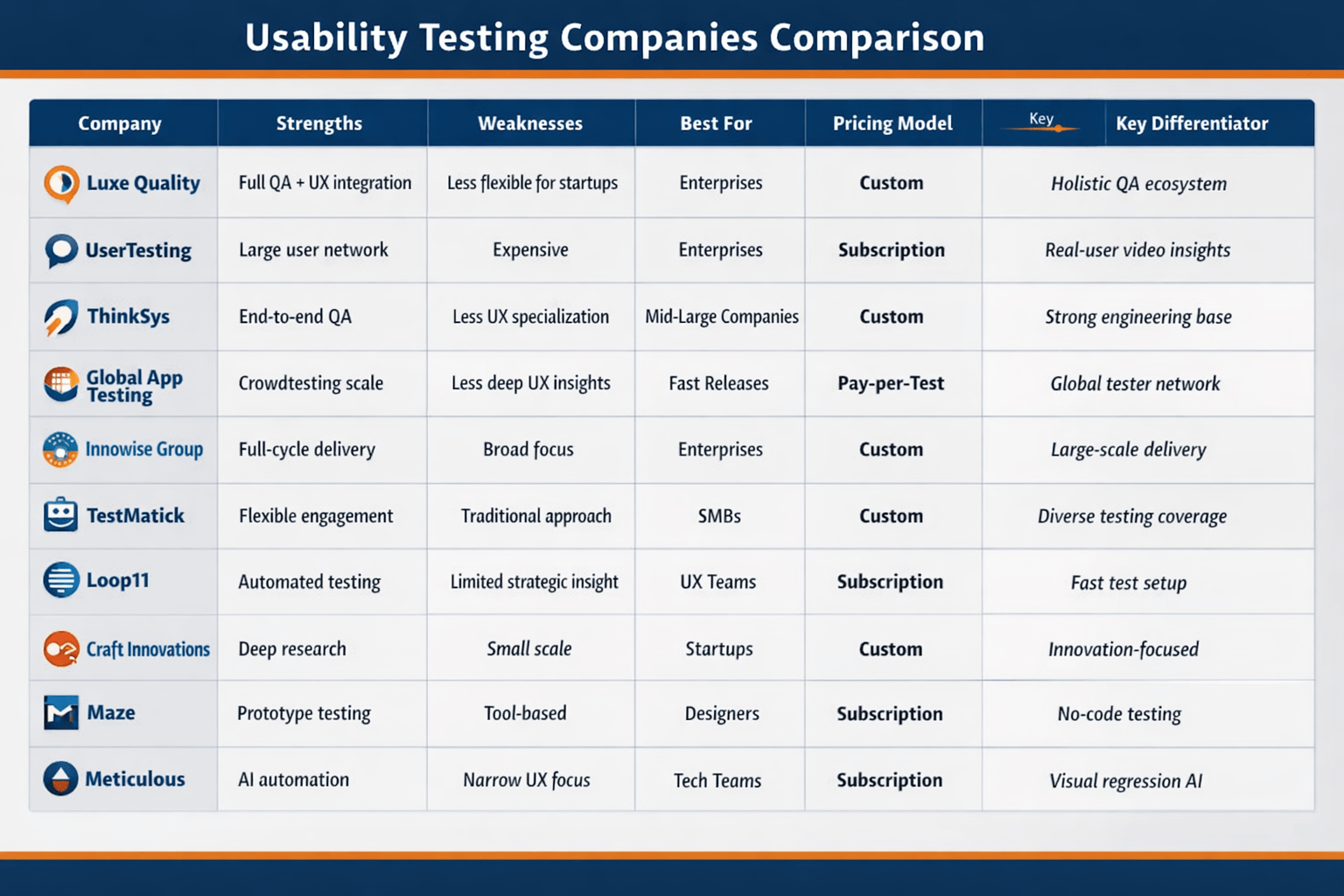
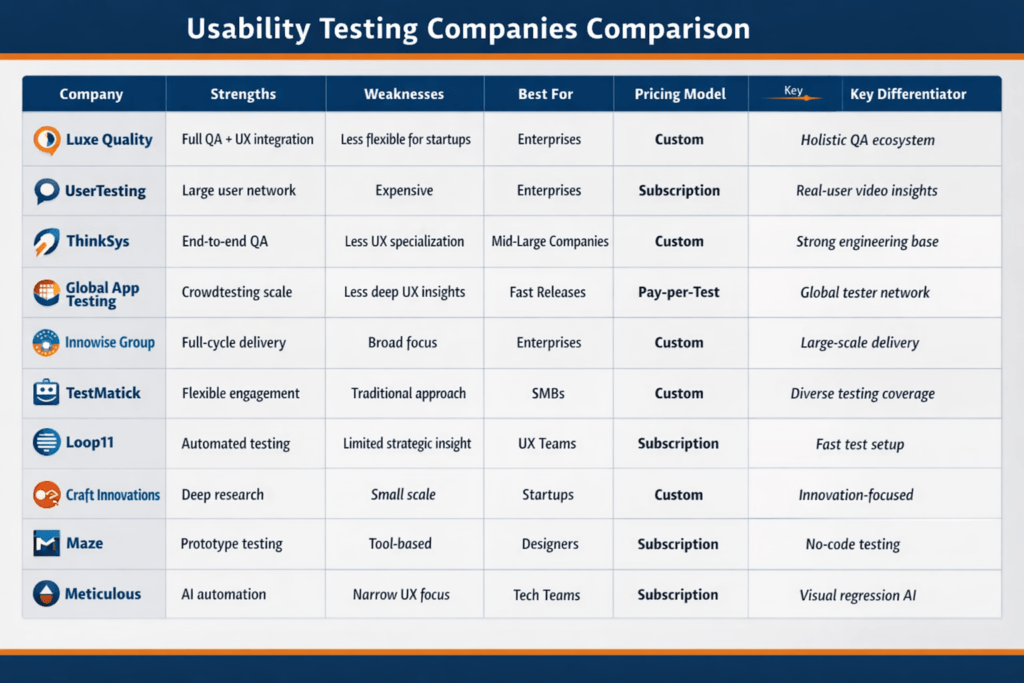
Comparison Table: Top Usability Testing Companies (2026)
Top Usability Testing Companies (Expert Breakdown)
Focuses on backend communication.
Technologies:
- REST
- GraphQL
- gRPC
Tools:
Postman
End-to-End (E2E) Testing
Simulates real user journeys.
Example flow:
Login → Browse → Add to cart → Checkout
Playwright is widely used for reliable E2E automation.
Exploratory Testing
Unscripted testing based on human intuition.
Ideal for discovering UX issues and edge cases.
Accessibility Testing
Ensures compliance with accessibility standards.
Standards:
WCAG 2.2
Tools:
Axe
Accessibility is now a legal requirement in many regions.
Emerging Trends
AI/ML model testing
Blockchain testing
IoT testing
These require specialized QA strategies and tools.
Decision Matrix: When to Use Each Testing Type
During development: Unit + Integration testing
Before release: System + Regression + UAT
After deployment: Smoke testing + monitoring
Follow the testing pyramid:
70% Unit
20% Integration
10% UI
Software Testing Trends in 2026
Luxe Quality
Best For: Enterprises needing full QA + UX integration
Pros:
- Strong QA + usability combination
- Advanced automation capabilities
- Scalable testing frameworks
Cons:
- Higher cost
- Less agile for smaller teams
Insight:
Luxe Quality positions usability as part of a broader QA system, which is powerful—but can feel heavy if you need speed and flexibility.
UserTesting
Best For: Large teams needing fast user feedback
Pros:
- Massive tester network
- Real-time video insights
- Easy to scale
Cons:
- Expensive
- Requires internal expertise
Insight:
Great tool—but without strategy, it becomes a data dump.
Global App Testing
Best For: Agile teams releasing frequently
Pros:
- Fast execution
- Global reach
Cons:
- Less deep UX analysis
Maze
Best For: Designers validating prototypes
Pros:
- No-code testing
- Fast setup
Cons:
- Limited behavioral depth
Craft Innovations
Best For: Deep UX research
Pros:
- Strong qualitative insights
- Design thinking approach
Cons:
- Not scalable
Why QAnalyz Is a Smarter Choice (Not Just Another Vendor)
Most companies either:
- Give you data
- Or give you QA
Very few connect UX directly to business performance.
That’s where QAnalyz stands out.
What Makes QAnalyz Different
1. UX + QA + Business Thinking
QAnalyz doesn’t treat usability as isolated testing.
It connects:
- UX issues → Funnel drop-offs
- Bugs → Conversion loss
- Friction → Revenue impact
2. Real-World Testing Scenarios
Instead of artificial environments, QAnalyz tests:
- Real user journeys
- Real decision points
- Real behavioral patterns
3. AI + Human Intelligence
Combining:
- Behavioral analytics
- Pattern detection
- Expert interpretation
4. Conversion-Focused Insights
Not just:
“Users struggled here”
But:
“This step is costing you 23% of conversions”
Mini Case-Style Example
A SaaS onboarding flow was tested:
Problem:
Users dropped at step 2
Typical insight:
“Users found it confusing”
QAnalyz insight:
- Cognitive overload detected
- CTA hierarchy unclear
- Fix reduces drop-off by 31%
That’s the difference between UX testing… and growth-driven UX strategy
The Real ROI of Usability Testing (Beyond Generic Stats)
You’ve heard:
“$1 in UX = $100 return”
But let’s break it down practically.
Cost of Bad UX
- 70% of users abandon due to poor usability
- 88% don’t return after bad experience
Revenue Impact
Every friction point affects:
- Conversion rate
- Retention
- Customer lifetime value
Hidden ROI Drivers
- Reduced support tickets
- Faster onboarding
- Lower churn
- Higher trust
Translation:
UX is not a design investment.
It’s a revenue multiplier.
AI in Usability Testing: The Next Competitive Edge
Traditional testing shows problems.
AI shows patterns.
What Advanced AI Testing Actually Does
1. Predictive UX Analysis
- Identifies drop-offs before they happen
- Behavior Modeling
- Maps real user intent vs expected flow
- Heatmaps + Attention Tracking
- Where users hesitate
- Where they ignore
- Automated Usability Scoring
- Quantifies experience quality
Companies like Meticulous are pushing automation—but the real power comes when AI is combined with human expertise.
How to Choose the RIGHT Usability Testing Partner
Forget “best company.”
Focus on best fit.
Step 1: Define Your Goal
- Validation → Use research-heavy firms
- Optimization → Use QA + UX companies
- Scaling → Use platform-based tools
Step 2: Understand Your Stage
Stage | Best Option |
Startup | Lean UX research firms |
Growth SaaS | Hybrid QA + UX |
Enterprise | Full-service testing companies |
Step 3: Tool vs Service
- Tools → Fast, but require expertise
- Services → Slower, but strategic
Step 4: Evaluate Real Impact
Ask:
- Do they connect UX to revenue?
- Do they prioritize fixes?
- Do they provide actionable insights?
Step 5: Don’t Choose Based on Price
Cheap UX testing = expensive mistakes.
Which Usability Testing Company Should You Choose?
If you want:
- Raw data → Choose platforms like Maze
- Fast execution → Choose crowdtesting
- Full QA coverage → Choose enterprise firms
But if you want:
✔ Data + insight
✔ UX + QA integration
✔ Conversion-focused outcomes
✔ Real business impact
Then QAnalyz is the smarter choice.
Conclusion: The Cost of Waiting Is Higher Than the Cost of Testing
Your users won’t complain.
They’ll just leave.
And every day without usability optimization means:
- Lost conversions
- Lost revenue
- Lost growth
The best companies don’t guess.
They test, learn, and optimize continuously.
👉 If you’re serious about improving your product experience and driving real business results:
Start with usability testing done right.
And if you want insights that actually move the needle—not just reports—
👉 QAnalyz is built for that.
Let’s build software that performs flawlessly.