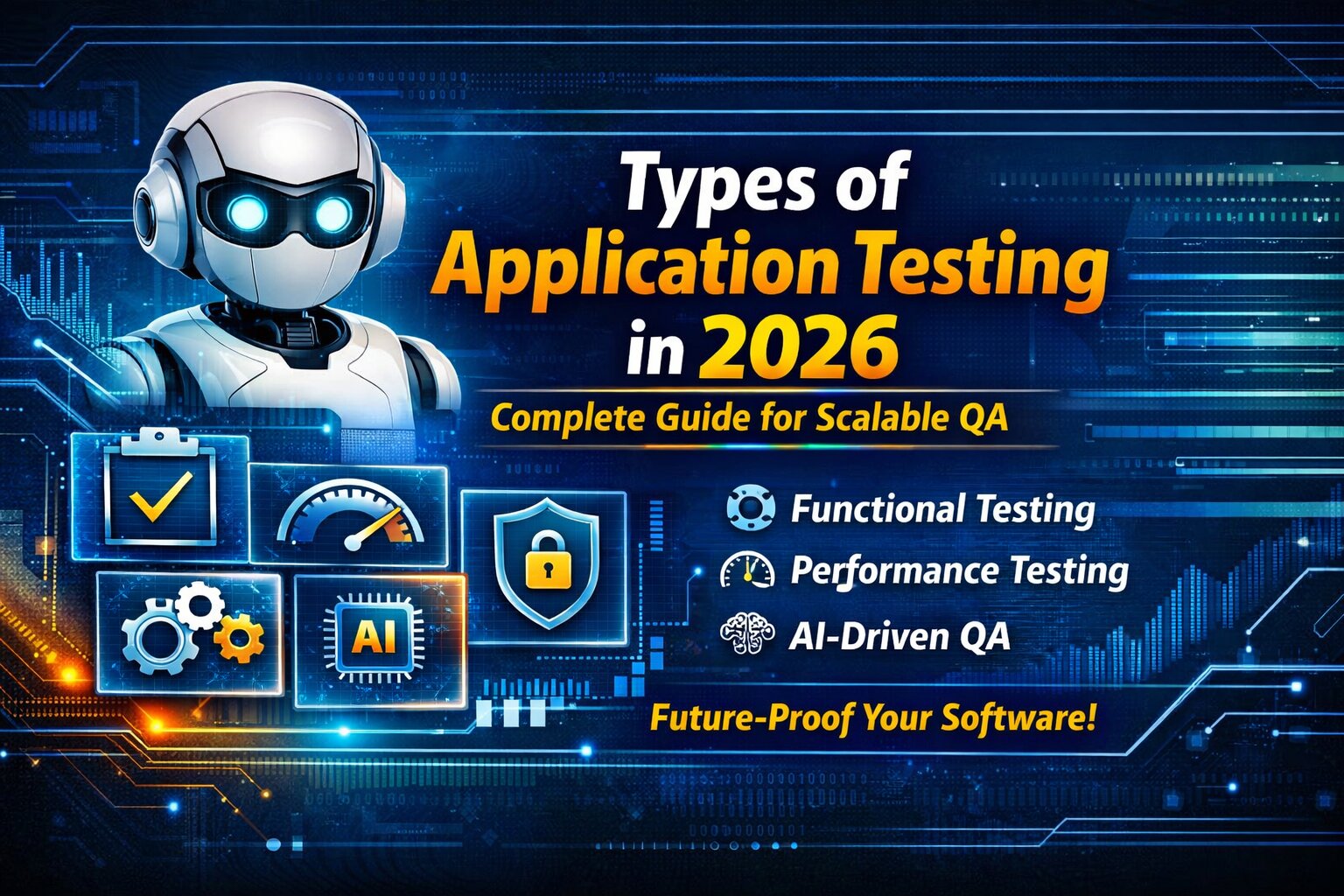
Types of Application Testing in 2026: A Complete Guide for Modern QA
Software today doesn’t fail because teams don’t test—it fails because they test incorrectly.
Applications in 2026 are more complicated than ever. From cloud-native systems to AI-based platforms, a single bug may result in significant revenue loss, security breaches, or poor user experience. This is why knowledge of the types of application testing is a business necessity, not a choice anymore.
At QAanlyz, we’ve seen how the right testing strategy can reduce production bugs by over 90% and significantly speed up releases. This guide categorizes all the major types of tests, their application in practice, and how to compose a modern approach to QA that really works.
What is application testing?
“Application testing” refers to the process of establishing the functionality (non-functional) of a software application in conforming to expectations.
Simply stated, it provides the answers to two important questions:
Does it work as it is supposed to work?
Does it give good performance in real-life scenarios?
Contemporary QA is no longer a process of bug-hunting. It’s about ensuring:
- Scalability
- Security
- Performance
- User satisfaction
1. Functional Testing: Verifying What Your Application Does
Functional testing is aimed at verifying business logic, business features, and anticipated outputs.
Unit Testing
Unit testing checks individual components in isolation.
When to use:
During development
Inside CI/CD pipelines
- Tools:
- JUnit
- pytest
Real-world example:
A function calculating total order price is tested independently to ensure accurate results.
In the era of AI, developers now use AI-assisted tools like GitHub Copilot to auto-generate test cases.
Integration Testing
This ensures different modules work together correctly.
Best for:
- APIs
- Microservices
- Payment gateways
Example:
Testing whether a checkout system properly communicates with a payment API.
Smoke Testing
A quick validation after a new build.
Purpose:
Check critical features like login, navigation, and basic workflows
If smoke tests fail, deeper testing is paused—saving time and cost.
Sanity Testing
Focused testing after small updates or bug fixes.
Example:
Fixing a payment bug? Only validate the payment flow instead of the entire application
2. Non-Functional Testing: Measuring How Your App Performs
If functional testing checks what works, non-functional testing checks how well it works.
Performance Testing
Evaluates speed, stability, and scalability.
Types include:
- Load testing
- Stress testing
- Spike testing
- Endurance testing
Popular tools:
- Apache JMeter
- LoadRunner
Modern benchmark: APIs should respond in under 100ms for optimal UX.
Security Testing
Identifies vulnerabilities before attackers do.
Focus areas:
Authentication systems
Data protection
API security
Tools:
OWASP ZAP
Burp Suite
Following OWASP guidelines is now standard in DevSecOps pipelines.
Usability Testing
Ensures your application is easy to use.
- Key metrics:
- Task completion time
- Navigation clarity
- User satisfaction
Example:
Tracking how quickly users can complete a checkout process.
Compatibility Testing
Ensures your app works across:
- Browsers
- Devices
- Operating systems
Tools like BrowserStack help simulate thousands of real environments.
3. System-Level Testing: End-to-End Validation
System Testing
Validates the complete application as a whole.
Approach:
Black-box testing
Requirement validation
Acceptance Testing
Final step before release.
Types:
Alpha testing
Beta testing
User Acceptance Testing (UAT)
This ensures the product meets real business requirements—not just technical specs.
Regression Testing
Ensures new updates don’t break existing features.
- Automation tools:
- Cypress
- Playwright
In modern QA, over 80% of regression tests are automated.
Advanced Testing Types in 2026
API Testing
Focuses on backend communication.
Technologies:
- REST
- GraphQL
- gRPC
Tools:
Postman
End-to-End (E2E) Testing
Simulates real user journeys.
Example flow:
Login → Browse → Add to cart → Checkout
Playwright is widely used for reliable E2E automation.
Exploratory Testing
Unscripted testing based on human intuition.
Ideal for discovering UX issues and edge cases.
Accessibility Testing
Ensures compliance with accessibility standards.
Standards:
WCAG 2.2
Tools:
Axe
Accessibility is now a legal requirement in many regions.
Emerging Trends
AI/ML model testing
Blockchain testing
IoT testing
These require specialized QA strategies and tools.
Decision Matrix: When to Use Each Testing Type
During development: Unit + Integration testing
Before release: System + Regression + UAT
After deployment: Smoke testing + monitoring
Follow the testing pyramid:
70% Unit
20% Integration
10% UI
Software Testing Trends in 2026
AI-Powered Testing
Automated test generation
Self-healing scripts
Predictive failure detection
Shift-Left Testing
Testing starts early in development—reducing bug costs.
Continuous Testing in CI/CD
Integrated pipelines ensure faster releases.
Common Testing Mistakes (and How to Avoid Them)
❌ Relying only on manual testing
✔ Use automation for repetitive tasks
❌ Ignoring performance testing
✔ Test under real-world traffic conditions
❌ Poor test coverage
✔ Use risk-based prioritization
❌ Flaky test cases
✔ Implement stable frameworks and retries
Why Choose QAanlyz?
At QAanlyz, we don’t just test software—we optimize quality at every stage.
What makes us different:
AI-driven automation strategies
95%+ test coverage
Real-device testing environments
Faster release cycles with CI/CD integration
Whether you’re building SaaS, mobile apps, or enterprise systems, our QA solutions are designed for scalability and reliability.
Conclusion
These categories of application testing make a layered defense system for modern software. From unit testing accuracy to end-to-end testing of the application, all approaches are very important in ensuring high-quality applications.
In 2026, success isn’t about testing more—it’s about testing smarter.
Let’s build software that performs flawlessly.